
Welcome to the Digital Archive
Discover, read, and download the definitive collection of Asia’s first Nobel Laureate’s timeless poetry, stories, and plays—completely free and formatted for modern devices.
The Life of Rabindranath Tagore (1861–1941)
Rabindranath Tagore, who was born in Calcutta, India, into an aristocratic and quite progressive family, truly was a remarkable polymath. He reshaped Bengali literature, as well as its music, and even Indian art in a very significant way. He received his education at home and spent time exploring nature, classical Sanskrit, and the philosophy of the Upanishads, which all went on to deeply affect how he saw the world. People o͏ften called him “Gurudev” or even the “Bard of Bengal.” His creative talent covered many forms: poetry, novels, essays, plays, and even painting when he was o͏lder.
In 1913, something very important happened; Tagore became the first person from outside Europe to get the Nobel Prize in Literature. This award was for his great work, Gitanjali, which means “Song Offerings.” This book contained a lot of poems that were very rhythmic and also very spiritual, and they were admired all over the world. He wrote a lot of music too, over 2,000 so͏ngs are known as Rabindra Sangeet. His impact on South Asian culture is still recognized today because he wrote the national anthems for two different countries: India’s “Jana Gana Mana” and Bangladesh’s “Amar Shonar Bangla”..
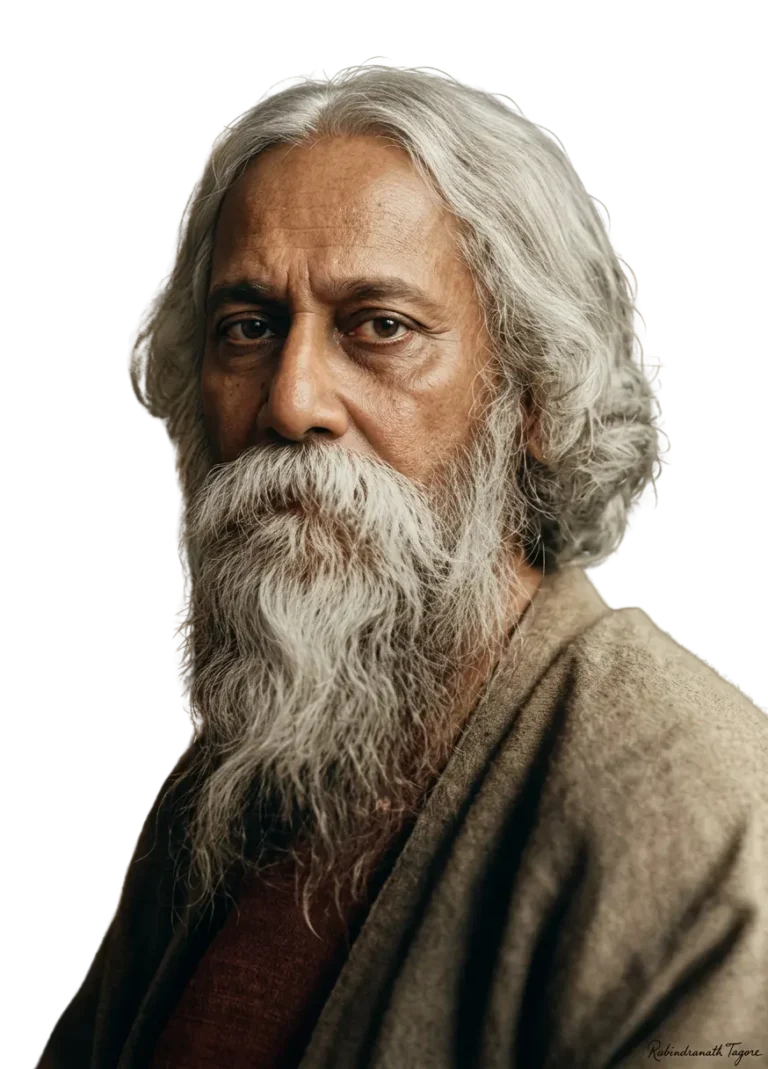
But Tagore was more than just an artist. He was really strong in his support for humanism, speaking out against imperialism, and also worked towards educational reform. He did not like the strict, rote learning methods that were common in British India during that time. So, he set up an experimental school, and later a university, called Visva-Bharati, in Santiniketan. His idea there was to bring together Eastern and Western traditions. Although the British Crown made him a knight.
Chronology of Tagore’s Life
-
1861Born on 7 May at Jorasanko, the family home in Calcutta.
-
1871Admitted to Bengal Academy, an Anglo-Indian School in Calcutta.
-
1873Goes with his father Debendranath Tagore on a tour of the Western Himalayas.
-
1875His mother dies.
-
1877Starts to publish poems and articles regularly in his family’s monthly journal, Bharati.
-
1878Goes to Ahmedabad to study English.
-
1879Comes to London and is admitted to University College.
-
1880Returns to India without completing any formal course of study. His first book, Sandhya Sangit (Evening Songs) is acclaimed by Bankimchandra Chatterji, the leading writer of the day.
-
1883Marries Mrinalini Devi.
-
1884His sister-in-law Kadambari commits suicide.
-
1885Takes charge of Bengali magazine Balak.
-
1886His daughter Madhurilata is born.
-
1888His son Rathindranath is born.
-
1890Severely attacks the anti-Indian policy of Lord Cross. Takes charge of the Tagore Estate in East Bengal at Shelidaha.
-
1891Writes first six short stories including ‘Post Master’.
-
1894Elected Vice-President of Academy of Bengali Letters and becomes editor of Sadhana, the new family journal.
-
1895Writes a series of remarkable short stories including ‘Hungry Stones’.
-
1898Sedition Bill; arrest of Bal Gangadhar Tilak; Tagore reads his paper Kantha-Rodh (The Throttled) at a public meeting in Calcutta.
-
1899Moves to Santiniketan.
-
1900First collection of short stories published.
-
1901Establishes school at Santiniketan.
-
1902Wife dies on 23 November.
-
1905Father Debendranath dies at the age of eighty-eight. Agitation against Lord Curzon’s proposal to partition Bengal. Tagore advocates policy of constructive non-cooperation against the British.
-
1907His younger son Samindra dies.
-
1910Writes The King of the Dark Chamber. Bengali Gitanjali published.
-
1911Meets William Rothenstein and later Count Keyserling at Jorasanko.
-
1912English Gitanjali published by the India Society.
-
1913English versions of Gitanjali, Crescent Moon, The Gardener and Chitra published by Macmillan. 13 November Tagore awarded Nobel Prize for Literature.
-
1914Gandhi's students from Phoenix, South Africa come to Santiniketan. Publishes The Home and the World.
-
1915Receives knighthood. Meets Gandhi for the first time.
-
1916Travels to USA via Japan, giving lectures on Nationalism and Personality.
-
1918Formal foundation stone of Visva-Bharati is laid.
-
1919Cautions Gandhi against misuse of passive resistance. Renounces knighthood in protest at Jalianwallah Bagh massacre.
-
1920Leaves for England on a lecture tour to raise funds for Visva-Bharati. Travels to France, Holland and America.
-
1921Visits England, France, Switzerland, Germany, Sweden, Austria and Czechoslovakia. Returns to Santiniketan in July.
-
1922Visits China and Japan and then sails almost immediately upon returning home for South America; stays in Buenos Aires as the guest of Victoria Ocampo.
-
1925Gandhi visits Santiniketan; Tagore refuses to join his political campaign.
-
1926Travels to Italy (where he misguidedly visits Mussolini), Switzerland (where he stays with Romain Rolland), Austria, England, Norway, Sweden, Denmark, Germany (where he meets Einstein), Czechoslovakia, Bulgaria, Greece and Egypt.
-
1927Tour of Southeast Asia.
-
1928Starts painting.
-
1930Delivers Hibbert Lectures in Oxford (published as The Religion of Man). His paintings are exhibited in London, Birmingham, and several European capitals and in USA.
-
1931Letters from Russia published. Major 70th birthday Celebrations.
-
1932Accepts Calcutta Chair of Bengali.
-
1937Tagore falls seriously ill. Prantik (Borderland) poems published.
-
1938Exhibition of his paintings in London.
-
1940Tagore’s friend and supporter C. F. Andrews dies at Santiniketan. Oxford University holds special Convocation at Santiniketan to confer Doctorate on Tagore.
-
1941His final lecture, Crisis in Civilisation is read on his eightieth birthday. Dies 30 July.